

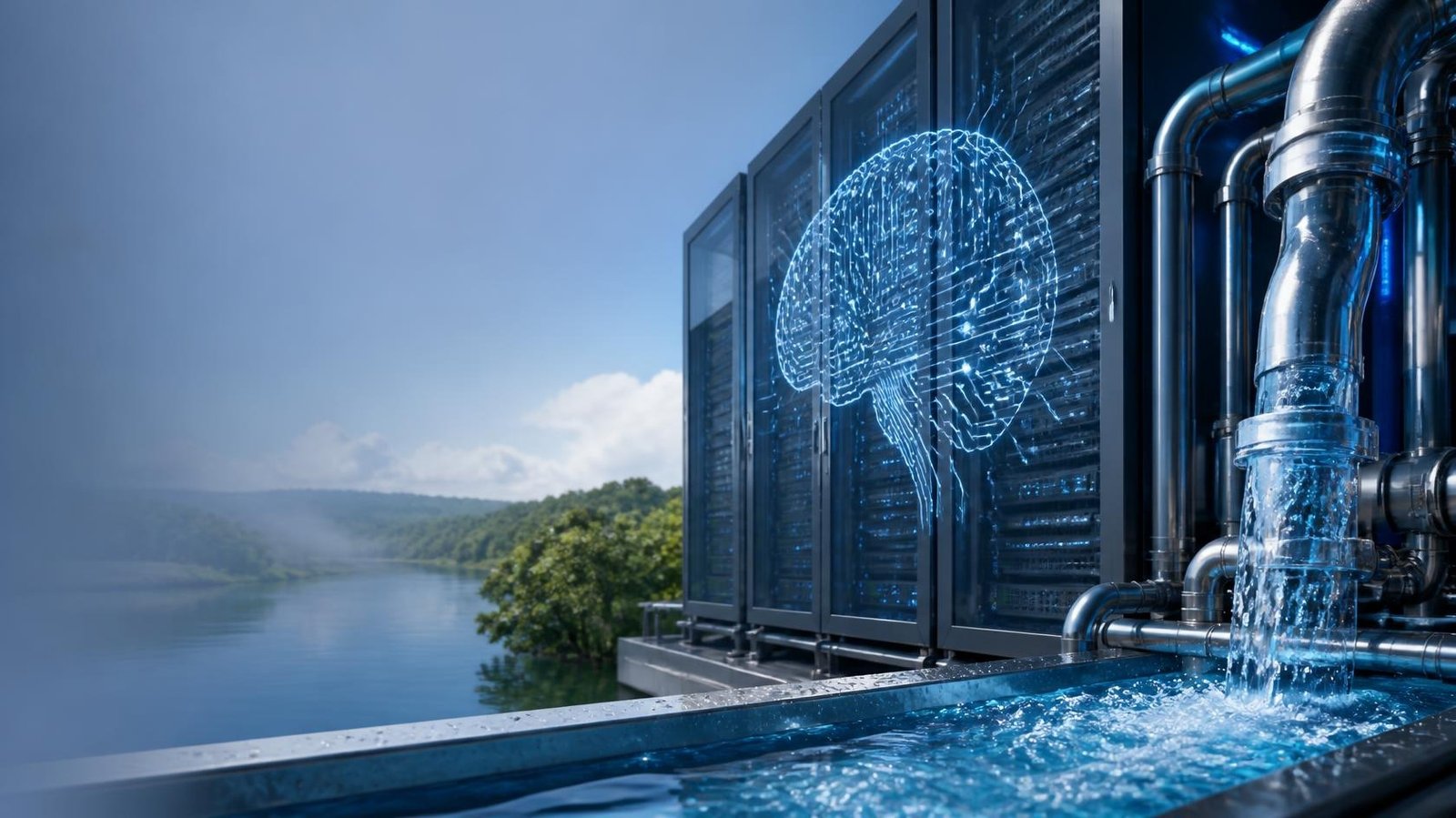
Artificial intelligence (AI) may seem like something that exists only on a computer or smartphone, but it depends on large physical data centers around the world. These facilities contain thousands of powerful servers that need electricity and cooling to operate.
This is where water comes in.
So, how does AI use water? Mainly, water is used to help cool the computer systems that run AI models. AI also has an indirect water footprint because generating electricity and manufacturing computer chips can require water.
The amount of water used can vary widely depending on the data center, cooling technology, location, electricity source, weather, and type of AI workload.
Why Does AI Need Water?
AI models require powerful computer chips, especially GPUs, to process large amounts of information. These chips use electricity while performing calculations.
Most of that electricity eventually becomes heat.
If the heat is not removed, servers can become too hot and may slow down, shut down, or suffer damage. Data centers therefore use cooling systems to keep equipment within safe operating temperatures.
Some cooling systems use water, particularly systems that rely on evaporation to remove heat.
In simple terms:
AI computing → electricity → heat → cooling → possible water use
This does not mean every AI task directly consumes a fixed amount of water. Different data centers use different cooling and energy systems.
How Do Data Centers Use Water to Cool AI?
There are several ways data centers can cool their equipment.
1. Evaporative cooling
Evaporative cooling is one of the important ways water can be used in data centers.
Warm air or water transfers heat away from computer equipment. Some of the water then evaporates, carrying heat away from the facility.
This method can be energy-efficient, but the evaporated water has to be replaced.
The amount of water needed depends on factors such as the outside temperature, humidity, cooling system design, and workload.
2. Liquid cooling
AI servers can generate a lot of heat, so some modern facilities use liquid cooling systems.
Instead of relying only on air, a liquid can carry heat away from components such as GPUs. Some liquid-cooling designs can reduce the need for evaporative water cooling.
However, “liquid cooling” does not automatically mean zero water use. The overall facility still needs to remove the collected heat, and that can involve different technologies.
3. Air cooling
Some data centers primarily use air-based cooling.
Air cooling can reduce direct water consumption, although it may require more electricity in certain situations. That creates an important trade-off: using less water directly does not necessarily mean using fewer resources overall.
Researchers therefore look at both water efficiency and energy efficiency when studying AI’s environmental impact.
AI Uses Water Indirectly Too
The answer to “how does AI use water” goes beyond the cooling systems inside data centers.
AI can have an indirect water footprint through the electricity it uses.
Power plants need different amounts of water depending on how they generate electricity. Some electricity-generation technologies use water for cooling or other processes.
That means an AI data center can be associated with water use even when the facility itself does not directly consume much water.
This is why researchers often separate AI’s water footprint into different categories, including water used for data-center cooling and water associated with electricity generation. DDOI+1
Does Training AI Use More Water?
Training a large AI model can require substantial computing power.
During training, the model processes huge amounts of data and performs billions or even trillions of calculations. Training can run continuously for long periods, which creates a large demand for electricity and cooling.
A widely cited research study estimated that training GPT-3 in Microsoft’s U.S. data centers could directly consume around 700,000 liters of freshwater through onsite cooling. The researchers also estimated additional water use associated with electricity generation. These figures are estimates for a particular model, location, and methodology—not a universal amount for training every AI model. DDOI+1
This distinction is important because AI water consumption can change significantly depending on where and when computing takes place.
Does Every AI Question Use Water?
Not every AI question uses the same amount of water.
When you ask an AI chatbot a question, the request is processed by computers in a data center. Those computers consume electricity and produce heat, which means the request can have a water footprint.
However, there is no single water-use number that applies to every AI prompt.
The amount can depend on:
- The AI model being used
- The length and complexity of the request
- The hardware processing it
- The data center’s cooling system
- The local weather
- The time of day
- The source of electricity
- How efficiently the data center operates
For example, Google published a 2025 estimate that a median Gemini Apps text prompt consumed about 0.26 milliliters of water under its specific measurement methodology. That figure should not be treated as a universal number for all AI systems because different models, facilities, and measurement methods can produce different results. GGoogle Cloud
How Much Water Does AI Use?
There is no single number for total AI water consumption.
One reason is that companies generally report water use for their broader data-center operations rather than separating AI workloads from other computing workloads. Researchers therefore have to use estimates and models to calculate AI’s share.
A 2026 review published in Water Research reported projections that AI’s global water footprint could reach 4.2–6.6 billion cubic meters annually by 2027, while emphasizing that water use comes from multiple sources, including cooling, electricity generation, and semiconductor manufacturing. SScienceDirect
These large estimates should be understood as projections rather than measurements of a single year’s confirmed AI water consumption.
Why Is AI’s Water Use a Concern?
Water is a local resource.
Using water in an area with abundant supplies may have a different impact from using the same amount in a drought-prone or water-stressed region.
This is one of the biggest reasons that simply asking, “How many liters does AI use?” does not tell the whole story.
Researchers also need to consider:
- Where the data center is located
- Whether the area has water shortages
- What type of water is being used
- Whether the water can be reused
- How much water the cooling system consumes
- Where the facility gets its electricity
- How much computing the facility performs
A small amount of water use in a highly water-stressed area can be more significant locally than a larger amount in a water-abundant region.
Can AI Data Centers Reduce Water Use?
Yes. Companies and researchers are exploring several ways to reduce the water footprint of AI infrastructure.
More efficient cooling
Improving cooling systems can reduce the amount of water needed to remove heat from servers.
Closed-loop cooling
Some cooling systems circulate liquid repeatedly rather than continually consuming fresh water. This can significantly reduce direct water consumption in suitable designs.
Recycled or reclaimed water
Data centers can sometimes use treated wastewater instead of drinking-quality freshwater for cooling.
Water-efficient locations
Building data centers in cooler climates can reduce cooling requirements. However, location decisions also need to consider electricity availability, water resources, infrastructure, and other environmental factors.
Better AI hardware
More efficient processors can perform more computing work using less electricity. Lower electricity use can reduce heat generation and potentially reduce cooling requirements.
Smaller and more efficient AI models
Not every AI task requires the largest available model. More efficient models can sometimes provide useful results while requiring fewer computing resources.
Researchers have also highlighted technologies such as direct liquid cooling, immersion cooling, recycled water, and waste-heat reuse as potential ways to reduce water demand. IIEEE Spectrum+1
Is AI’s Water Use the Same as Drinking Water?
Not necessarily.
When people hear that AI “uses water,” they may imagine that every AI question requires drinking water. The reality is more complicated.
Data centers can use different water sources and cooling technologies. Some facilities use freshwater, while others can use reclaimed or recycled water.
It is therefore important to distinguish between water withdrawal and water consumption.
Water withdrawal refers to water taken from a source. Water consumption generally refers to the portion that is not returned for immediate reuse, such as water lost through evaporation.
These two measurements can be very different.
What About the Water Used to Make AI Chips?
AI’s water footprint also extends beyond the data center.
Computer chips require complex manufacturing processes. Semiconductor manufacturing uses water for cleaning and processing during production.
This means the environmental footprint of AI hardware begins before a GPU or server reaches a data center.
Researchers sometimes describe this as part of AI’s embodied or supply-chain water footprint.
As a result, understanding the full water footprint of AI requires looking at the entire system—not just the water flowing through a data center’s cooling equipment. DDOI
Does Using AI Mean We Should Stop Using It?
AI’s water use is a legitimate environmental issue, but the impact of AI is not identical everywhere or for every application.
The more useful question is how AI infrastructure can become more resource-efficient as demand grows.
Better cooling systems, efficient hardware, responsible data-center locations, cleaner electricity, water recycling, and more transparent reporting can all help reduce environmental impacts.
At the same time, AI can potentially be used for applications that help manage water resources, improve weather forecasting, detect leaks, optimize irrigation, and support scientific research.
The goal is not simply to measure how much water AI uses. It is also to understand where that water comes from, why it is being used, and how efficiently it can be managed.
Frequently Asked Questions
How does AI use water?
AI primarily uses water indirectly through the data centers that run AI models. Water can be used to cool servers and remove the heat produced by computing equipment. Additional water may be associated with generating the electricity used by those servers and manufacturing AI hardware.
Does ChatGPT use water?
AI chatbots such as ChatGPT run on data-center infrastructure. That infrastructure requires electricity and cooling, so using an AI chatbot can have an associated water footprint. However, there is no universal amount of water used for every ChatGPT question.
How much water does one AI prompt use?
There is no single number that applies to every AI prompt. Water use varies based on the model, hardware, data center, cooling technology, electricity source, location, and workload. Some companies have published estimates for their own systems, but these should not be generalized to every AI service.
Why does AI need cooling?
AI processors use electricity and produce heat while performing calculations. Cooling systems remove this heat so the servers can continue operating safely and reliably.
Can AI use less water?
Yes. Data centers can reduce water consumption through more efficient cooling, closed-loop systems, reclaimed water, improved hardware, efficient AI models, and careful facility design and location.
Is AI bad for the environment because of water use?
AI has an environmental footprint that includes water, electricity, emissions, and hardware manufacturing. The size and impact of that footprint depend on how and where AI infrastructure is operated. Water use is one part of the broader environmental picture.
Final Thoughts
So, how does AI use water? The simplest answer is that AI itself does not “drink” water. The computers running AI produce heat, and some data centers use water-based cooling systems to remove that heat.
AI also has an indirect water footprint through electricity generation and the manufacturing of computer hardware.
As AI becomes more widely used, understanding this water footprint will become increasingly important. The good news is that technology can also help reduce it. More efficient chips, smarter cooling, recycled water, and better-designed data centers can all make AI less resource-intensive.

