

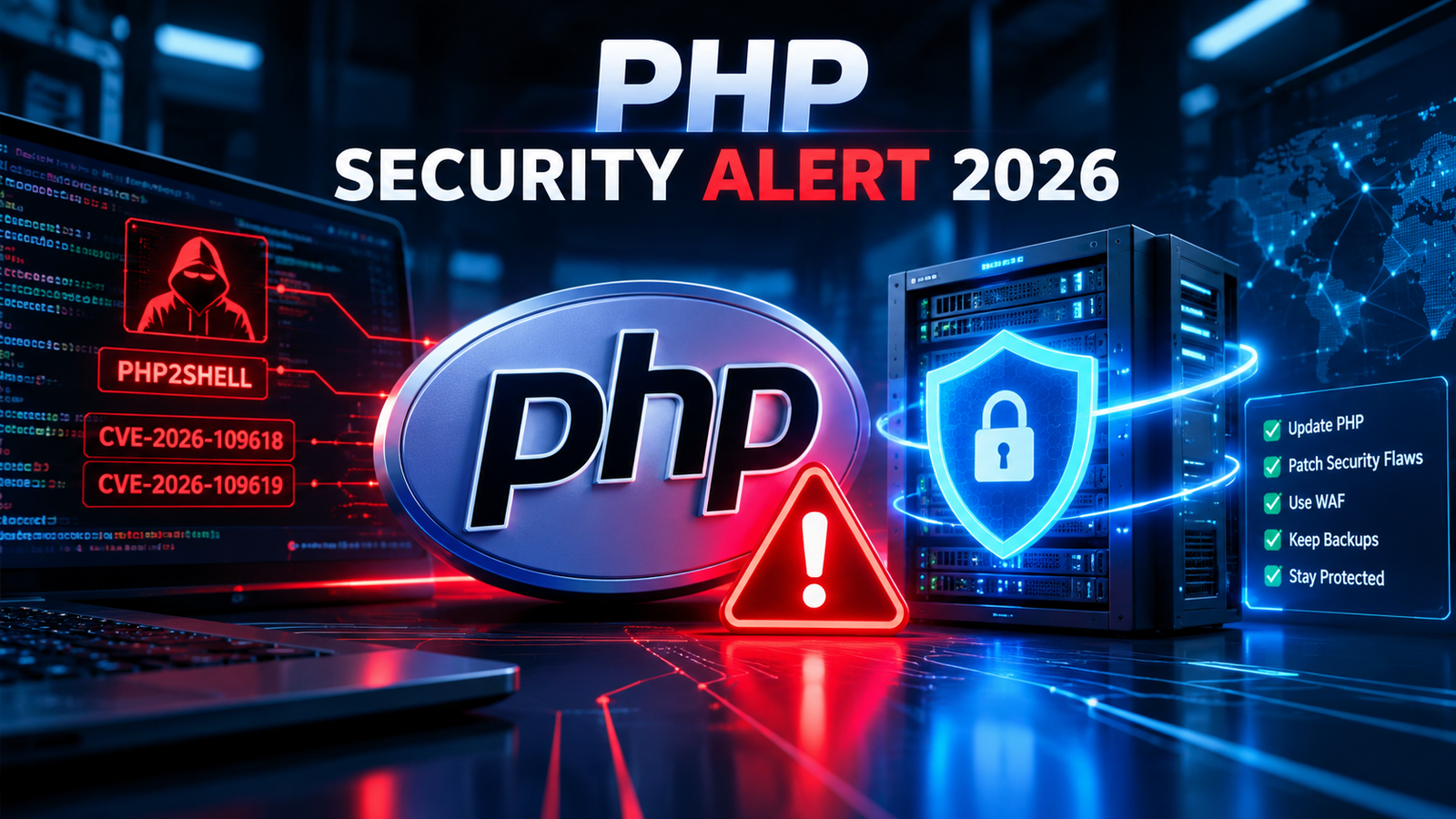
PHP is one of the most widely used programming languages for building websites and web applications. It powers popular platforms such as WordPress and helps websites display dynamic content, process forms, manage accounts, and connect to databases. However, a serious PHP vulnerability can put websites, servers, and sensitive information at risk.
In October 2026, security researchers disclosed two critical PHP security vulnerabilities known as PHP2Shell. These flaws, tracked as CVE-2026-109618 and CVE-2026-109619, can allow attackers to execute code remotely on affected servers without logging in. Security teams have urged website owners and hosting providers to apply the available security patches immediately.
This article explains what PHP is, what a PHP vulnerability means, why the October 2026 security issue matters, and how website owners can protect their websites.
What Is PHP?
PHP is an open-source, server-side scripting language used to build interactive websites and web applications. Unlike HTML, which mainly defines a webpage’s structure, PHP can process information on a server before sending the result to a visitor’s browser.
Developers use PHP for many common website functions, including:
- Creating dynamic webpages.
- Processing contact forms and user registrations.
- Connecting websites to databases.
- Managing website sessions and user accounts.
- Powering content management systems such as WordPress.
- Supporting online stores and web applications.
PHP is popular because it is flexible, widely supported, and compatible with many hosting environments. However, like any software, PHP can contain programming errors that create security risks.
What Is a PHP Vulnerability?
A PHP vulnerability is a weakness in the PHP programming language, its runtime, or the way a PHP application is configured and used. Attackers may exploit such a weakness to access information, disrupt website services, or gain control over a server.
PHP security vulnerabilities can affect different parts of a website. A flaw in a plugin may affect one application, while a flaw in the PHP core can potentially affect many applications running on vulnerable PHP versions.
Common PHP security issues include:
- Remote code execution.
- Memory corruption.
- Unauthorized access to sensitive information.
- Insecure session handling.
- SQL injection caused by unsafe database queries.
- Cross-site scripting caused by improperly handled output.
- Outdated PHP versions with known security flaws.
Not every PHP issue has the same severity. Some require specific configurations or application behavior, while critical flaws may expose internet-facing servers to serious attacks.
PHP Vulnerability 2026: What Happened in October?
In October 2026, researchers disclosed two critical vulnerabilities in the PHP core. The flaws became widely known as PHP2Shell because successful exploitation can allow remote code execution.
The vulnerabilities affect the PHP runtime itself rather than being limited to one WordPress plugin or website theme. This makes them particularly important for hosting providers, developers, and website administrators.
Security advisories identify the following issues:
- CVE-2026-109618: A vulnerability associated with memory handling during an out-of-memory condition.
- CVE-2026-109619: A vulnerability involving stale internal state that can reference memory after it has been released.
Both flaws have been reported as capable of enabling remote code execution under affected conditions. The potential impact includes unauthorized server activity, website compromise, and exposure of sensitive data.
The PHP development team released patched versions on October 21, 2026. Website owners should confirm their installed PHP version and follow the official security guidance for their hosting environment.
What Is PHP2Shell?
PHP2Shell is the name used for the newly disclosed group of critical PHP security flaws. These vulnerabilities are serious because an attacker may be able to trigger vulnerable behavior through a network request without first obtaining a legitimate account.
Remote code execution, often shortened to RCE, means that an attacker can cause a vulnerable system to run code without authorization. Depending on server permissions and configuration, this may lead to website defacement, unauthorized changes, data theft, or further compromise.
PHP2Shell is not simply a problem with one website builder. Because the weakness exists in the PHP runtime, applications that use affected PHP installations may also be exposed.
Potentially affected environments include:
- WordPress websites.
- Drupal and Joomla websites.
- PHP-based online stores.
- Laravel and Symfony applications.
- Websites using PHP-FPM or other PHP server configurations.
- Hosting environments that run vulnerable PHP versions.
The actual risk depends on the installed version, server configuration, exposure to the internet, and whether the appropriate security fixes have been applied.
CVE-2026-109618 Explained
CVE-2026-109618 is one of the critical PHP security vulnerabilities disclosed in October 2026.
The issue involves PHP’s handling of memory when an out-of-memory condition interrupts normal processing. Under certain circumstances, internal request data may not be fully initialized before cleanup operations attempt to use it.
Incorrect handling of this state can create a memory corruption condition that may lead to remote code execution.
Why Is This PHP Issue Serious?
If an attacker successfully exploits the flaw, the affected server may perform unauthorized operations. The possible consequences depend on the privileges available to the PHP process.
Website owners should not assume that a site is safe simply because its WordPress core, theme, and plugins are updated. The PHP runtime must also receive the appropriate security patch.
CVE-2026-109619 Explained
CVE-2026-109619 is the second critical vulnerability associated with PHP2Shell.
This issue involves internal PHP state that may continue to reference memory after that memory has been released. If the application or runtime later uses this stale state before it is properly reset, the resulting behavior can create a security weakness.
What Could Happen If the Vulnerability Is Exploited?
Successful exploitation may allow unauthorized code execution on an affected server. Depending on the environment, attackers could potentially alter website files, access information available to the PHP process, or disrupt normal website operations.
This is a PHP core security issue, so updating an individual application plugin is not a substitute for applying the relevant PHP security fix.
Which PHP Versions Are Affected?
The October 2026 PHP2Shell advisories identify the following patched release versions.
| PHP branch | Patched release |
|---|---|
| PHP 8.5 | 8.5.12 |
| PHP 8.4 | 8.4.27 |
| PHP 8.3 | 8.3.36 |
| PHP 8.2 | 8.2.35 |
Versions earlier than the relevant patched release in each branch may be affected. PHP 8.1 and older branches are no longer supported by the main PHP project, although some vendors may provide backported security fixes.
Important: These are the patched versions reported for CVE-2026-109618 and CVE-2026-109619. They should not be interpreted as a guarantee that every other PHP security issue is fixed. Check the latest PHP security advisories before choosing a version.
How to Protect Your Website From PHP Security Vulnerabilities
Website owners should treat critical PHP security updates as a priority. The following steps can help reduce risk.
1. Check Your Current PHP Version
Log in to your hosting control panel and find the PHP version assigned to your website. If you use a managed hosting provider, ask its support team to confirm the installed version and whether the PHP2Shell security fixes have been applied.
Do not assume that every website on the same hosting account uses the same PHP configuration.
2. Update PHP to a Patched Version
Upgrade to an appropriate patched, supported PHP release after checking compatibility with your website, plugins, and theme.
If your website uses WordPress, make a backup and test important functions after the update. If you manage a server directly, follow your operating system or PHP package provider’s security instructions.
3. Contact Your Hosting Provider
Some hosting providers manage PHP updates centrally. If you cannot change PHP versions yourself, contact your provider and ask:
- Is my website running a PHP version affected by PHP2Shell?
- Have the fixes for CVE-2026-109618 and CVE-2026-109619 been installed?
- Is my PHP branch still supported?
- Are any additional security actions required?
Ask for confirmation rather than relying on a general statement that the server is secure.
4. Keep WordPress and Plugins Updated
PHP security patches and WordPress updates address different parts of your website. Update WordPress core, themes, and plugins from trusted sources, and remove components you no longer use.
Avoid installing unknown plugins or modified software from untrusted websites.
5. Use a Web Application Firewall
A web application firewall (WAF) can help identify or block certain malicious web requests before they reach your application. Cloudflare, for example, reported deploying WAF protections for the disclosed PHP2Shell exploit patterns.
However, a firewall is an additional layer of protection, not a replacement for updating vulnerable PHP software. Protection can depend on configuration, traffic coverage, and the specific attack.
6. Back Up Your Website
Maintain recent backups of website files and databases. Store backups securely and test that you can restore them.
A backup can help with recovery after an incident, but it does not remove a vulnerability from the server.
7. Monitor for Suspicious Activity
Website administrators should review server and application logs for unusual activity, unexpected file changes, unfamiliar administrator accounts, or abnormal processes.
If you suspect a compromise, contact your hosting provider or a qualified security professional. Preserve relevant logs and avoid assuming that applying a patch alone will remove an attacker’s existing access.
Can a PHP Vulnerability Make Websites Go Down?
Yes. A serious PHP security issue can contribute to website downtime, although it is not the only possible cause.
A website may become unavailable because administrators temporarily disable access while applying emergency updates. Hosting providers may also restrict vulnerable services as a precaution. In other cases, an attack, a server configuration problem, or an unrelated hosting outage may cause downtime.
The phrase “websites down” therefore does not automatically mean that PHP2Shell caused the problem.
If your website is not loading, check your hosting provider’s status page, server logs, PHP error logs, and recent configuration changes. Ask your provider whether a security mitigation or service interruption is involved.
What Is Cloudflare’s Role in PHP Security?
Cloudflare provides services such as content delivery, traffic filtering, and web application firewall protection. Its WAF can help block certain requests associated with known attacks.
During the October 2026 PHP2Shell disclosure, Cloudflare reported deploying protections for known exploit patterns for customers using its WAF.
Website owners should understand the limits of this protection. Cloudflare does not automatically upgrade the PHP runtime installed on a hosting server. Website operators still need to confirm that their PHP version is patched.
For better security, combine a patched PHP installation with a properly configured firewall, strong account protection, secure backups, and regular monitoring.
How Artificial Intelligence Helped Identify PHP Security Issues
Artificial intelligence has become a useful tool in cybersecurity research. AI-assisted systems can help researchers analyze code, investigate unusual program behavior, and identify weaknesses that may be difficult to recognize through conventional review alone.
Reports about PHP2Shell describe AI-assisted vulnerability research and coordinated work among security researchers, software maintainers, and security providers.
AI does not eliminate the need for expert review. Researchers must validate findings, developers must prepare fixes, and administrators must install those fixes correctly.
The incident demonstrates how artificial intelligence can support defensive security work while also highlighting the importance of responsible disclosure and rapid patching.
What Does “Black October” Mean in Cybersecurity?
The phrase “Black October” can be used informally to describe a month marked by serious security incidents or widespread technology problems. It is not the official name of the PHP2Shell vulnerabilities.
When discussing PHP vulnerability October 2026 news, it is more accurate to describe the confirmed security issue by its name, PHP2Shell, and its CVE identifiers.
This approach helps readers distinguish verified security information from dramatic headlines, speculation, and unrelated outages.
Are All PHP Websites Vulnerable?
Not necessarily. The relevant factor is whether a website’s server runs an affected PHP version without the appropriate fix.
A website may be protected if its hosting provider has installed the relevant patch or an applicable vendor-supported backport. A website that uses an unaffected configuration or a fully patched runtime may have a different level of exposure.
However, website owners should verify their actual server environment instead of assuming that a website is safe because it loads normally.
What About MSUFCU, GOG, and Pokémon Apps?
Searches related to PHP security news may include names such as MSUFCU, GOG, or Pokémon apps. These names do not, by themselves, establish that the organizations, services, or applications are affected by PHP2Shell.
A website or app would need to be assessed based on its actual technology stack, server configuration, and patch status. Do not treat a keyword association, search trend, or social media post as proof that a named service has been compromised.
Similarly, claims about Pokémon apps being offline should be verified through an official service announcement or a reliable incident report. An application may be unavailable for many reasons unrelated to PHP security.
How to Check Whether Your Website Is Secure
Use this simple checklist to review your website’s PHP security status:
- [ ] Confirm the PHP version used by your website.
- [ ] Verify that the relevant PHP2Shell patch is installed.
- [ ] Confirm that your PHP branch is supported or covered by a trusted vendor’s security updates.
- [ ] Update WordPress, themes, plugins, and other website software.
- [ ] Check that backups are recent and restorable.
- [ ] Review security logs if suspicious activity is reported.
- [ ] Confirm that firewall protections are enabled where appropriate.
- [ ] Contact your hosting provider if you cannot verify the server’s status.
Completing this checklist can improve your security posture, but it does not replace a full security assessment when compromise is suspected.
Frequently Asked Questions
What is a PHP vulnerability?
A PHP vulnerability is a weakness in the PHP language runtime, application code, or configuration that could allow unauthorized access, information disclosure, or other harmful activity.
What is PHP2Shell?
PHP2Shell is the name associated with critical PHP security flaws disclosed in October 2026 that can enable remote code execution on affected servers.
What are CVE-2026-109618 and CVE-2026-109619?
They are identifiers for two critical PHP security vulnerabilities involving memory handling and stale internal state. Successful exploitation can allow remote code execution under affected conditions.
How do I fix the PHP vulnerability in 2026?
Confirm your installed PHP version, upgrade to a patched and supported release, and follow the official guidance from PHP or your hosting provider. Also update your website’s other software.
Can Cloudflare protect my website from PHP2Shell?
Cloudflare reported deploying WAF protections for known PHP2Shell exploit patterns. These protections can reduce exposure, but they do not replace the need to patch PHP.
Should I update WordPress to fix PHP2Shell?
Updating WordPress is important, but the vulnerability is in the PHP runtime. You must also ensure that the PHP version running your website has the appropriate security fix.
Can a PHP security issue cause data theft?
Yes. If an attacker successfully exploits a serious PHP vulnerability, they may be able to execute unauthorized code or access data available to the affected server process. The actual impact depends on permissions and configuration.
Is PHP still safe to use?
Yes, PHP remains a widely used technology. Like any software platform, it requires supported versions, timely security updates, secure application code, and proper server configuration.
Conclusion
The October 2026 PHP2Shell disclosure highlights the importance of keeping web servers updated. CVE-2026-109618 and CVE-2026-109619 are critical PHP security vulnerabilities that can expose affected systems to remote code execution.
Website owners should confirm their PHP versions, apply the appropriate patches, keep website software updated, and work with their hosting providers to address any remaining risks.
Whether you manage a WordPress blog, an online store, or a custom web application, regular maintenance and prompt security updates are essential for protecting your website and its visitors.


