

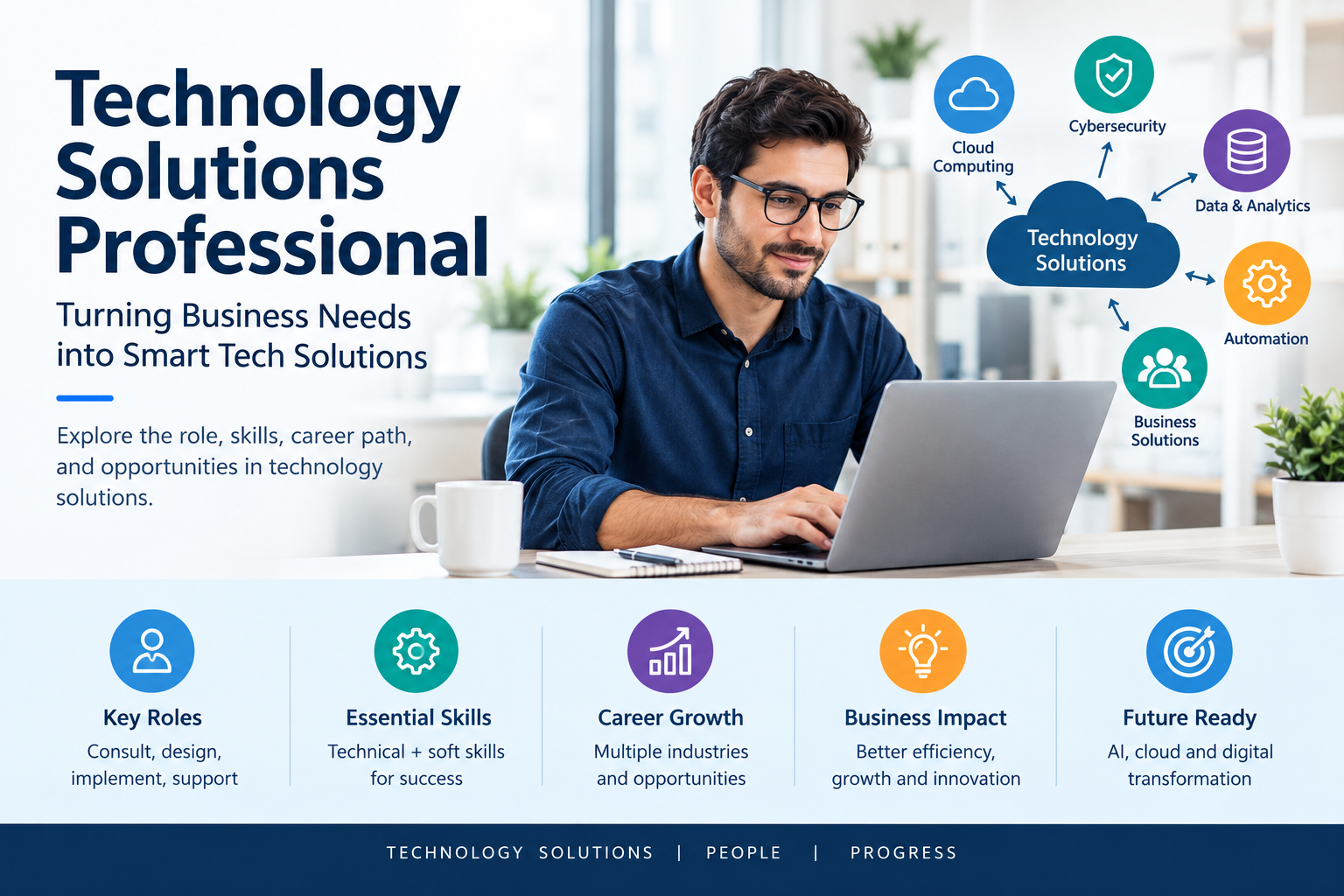
Technology has become an essential part of modern business. From cloud computing and cybersecurity to software development and data management, organizations rely on technology to improve efficiency, reduce costs, and serve customers better. This growing demand has created opportunities for the technology solutions professional, a specialist who helps businesses identify technology challenges and implement practical solutions.
But what exactly does a technology solutions professional do? What skills are required for this career, and why are these professionals important to modern organizations? This guide explains everything you need to know.
What Is a Technology Solutions Professional?
A technology solutions professional is a technology specialist who helps organizations solve business problems through effective use of technology.
Rather than focusing only on one technical area, these professionals often work across different technologies and business functions. They may analyze business requirements, recommend software or hardware, assist with implementation, manage technology projects, and help organizations improve existing systems.
The exact responsibilities can vary depending on the company and job title. A technology solutions professional might work as a solutions consultant, technology consultant, systems analyst, IT specialist, solutions architect, or technology project professional.
In simple terms, their job is to connect business needs with technology solutions.
What Does a Technology Solutions Professional Do?
The day-to-day responsibilities of a technology solutions professional depend on their specialization and employer. Common responsibilities include:
1. Understanding Business Requirements
Before recommending technology, professionals need to understand the organization’s goals and challenges.
They may communicate with managers, employees, customers, and technical teams to identify problems and determine what the business actually needs.
2. Designing Technology Solutions
After identifying a problem, they can help design a technology-based solution. This could involve:
- Business software
- Cloud platforms
- Data systems
- Cybersecurity tools
- Enterprise applications
- Network infrastructure
- Automation technologies
- Customer relationship management systems
The objective is to create a solution that is practical, scalable, secure, and aligned with business requirements.
3. Implementing New Technologies
A technology solution is useful only when it works effectively in the real world. Professionals may therefore participate in installation, configuration, integration, testing, and deployment.
They may also coordinate with developers, IT teams, vendors, and business stakeholders throughout implementation.
4. Troubleshooting Technology Problems
Technology solutions professionals may investigate technical issues and help organizations resolve them.
This can include identifying system failures, integration problems, performance issues, security concerns, or user-experience problems.
5. Improving Existing Systems
Technology isn’t always about replacing an old system. Sometimes the better approach is to improve an existing platform.
A professional may analyze current processes and recommend automation, integrations, upgrades, or workflow improvements.
Why Are Technology Solutions Professionals Important?
Businesses increasingly depend on technology to operate efficiently. However, choosing and implementing the right technology can be complicated.
A technology solutions professional can help organizations bridge the gap between technical capabilities and business objectives.
For example, a company may want to reduce repetitive administrative work. Instead of simply purchasing another software product, a technology professional can examine the workflow, identify bottlenecks, evaluate automation options, and help implement an appropriate solution.
This approach can help businesses make more informed technology investments.
Key Skills of a Technology Solutions Professional
Successful professionals in this field generally need a combination of technical knowledge and business skills.
Technical Skills
Depending on the role, useful technical skills may include:
- Cloud computing
- Networking
- Cybersecurity
- Databases
- Software development
- Systems integration
- Data analysis
- IT infrastructure
- Automation
- Enterprise software
The required technical skills vary considerably between positions.
Communication Skills
Technology professionals frequently work with people who have different levels of technical knowledge.
Being able to explain complicated concepts in clear language is therefore extremely valuable.
Problem-Solving Skills
Many technology roles involve investigating problems, evaluating alternatives, and developing practical solutions.
Strong analytical and problem-solving abilities can help professionals approach these challenges systematically.
Project Management
Technology implementations often involve multiple teams, deadlines, budgets, and dependencies.
Knowledge of project management can help professionals organize tasks and keep technology projects moving toward their objectives.
Business Understanding
Technical knowledge alone may not be enough. A strong technology solutions professional understands how technology affects business operations, customers, costs, and long-term objectives.
Technology Solutions Professional vs. IT Professional
The terms can overlap, but they don’t always describe exactly the same role.
An IT professional may focus primarily on maintaining and supporting an organization’s technology environment. This can include networks, devices, servers, applications, and technical support.
A technology solutions professional may have a broader focus, particularly around identifying business requirements and designing or implementing solutions to address them.
However, job descriptions differ between organizations, so the responsibilities should always be evaluated individually.
Common Industries That Hire Technology Solutions Professionals
Technology solutions professionals can work across many industries, including:
- Healthcare
- Banking and financial services
- Retail
- Manufacturing
- Telecommunications
- Education
- Government
- E-commerce
- Logistics
- Professional services
- Technology companies
Almost any organization that relies on digital systems can require professionals who understand how to connect technology with business requirements.
How to Become a Technology Solutions Professional
There isn’t one universal career path. However, many professionals begin with education or experience in information technology, computer science, business information systems, engineering, or a related discipline.
A typical development path may include:
Step 1: Build a Technical Foundation
Learn fundamental concepts such as computer systems, networking, databases, software, cloud computing, and cybersecurity.
Step 2: Develop Business Knowledge
Understand how organizations operate and how technology can improve processes, customer experiences, and decision-making.
Step 3: Gain Practical Experience
Internships, entry-level IT positions, freelance projects, certifications, and hands-on technology projects can help develop practical experience.
Step 4: Choose a Specialization
As your career develops, you may specialize in areas such as cloud solutions, cybersecurity, data, enterprise software, automation, or systems architecture.
Step 5: Continue Learning
Technology changes rapidly. Professionals need to continually update their knowledge and adapt to new tools, platforms, and industry practices.
Benefits of Working in Technology Solutions
A career as a technology solutions professional can offer exposure to both technical and business challenges.
Some potential benefits include:
- Working with modern technologies
- Solving real-world business problems
- Developing technical and consulting skills
- Working across different industries
- Opportunities for career specialization
- Continuous learning and professional development
The career can be particularly suitable for people who enjoy technology but also like communication, analysis, and business problem-solving.
How Businesses Can Choose the Right Technology Solution
Organizations should avoid selecting technology simply because it is popular or new.
A better approach is to begin with the business problem.
Ask questions such as:
- What problem are we trying to solve?
- Who will use the technology?
- What features are actually necessary?
- How will the solution integrate with existing systems?
- What are the implementation and ongoing costs?
- How will security and privacy be handled?
- Can the solution scale as the organization grows?
- How will success be measured?
A technology solutions professional can help answer these questions and compare potential approaches.
The Future of Technology Solutions
Emerging technologies are changing how businesses operate. Artificial intelligence, cloud computing, automation, cybersecurity, data analytics, and connected systems are creating new opportunities as well as new challenges.
As organizations adopt more digital technologies, professionals who can understand both technology and business requirements will continue to play an important role.
The future of technology solutions is therefore likely to involve not only implementing technology but also helping organizations determine where technology can create meaningful business value.
Frequently Asked Questions
What is a technology solutions professional?
A technology solutions professional helps organizations identify business and technology challenges and develop, implement, or manage technology solutions that address those challenges.
What skills does a technology solutions professional need?
Important skills can include technical knowledge, analytical thinking, communication, project management, problem-solving, and an understanding of business operations.
Is technology solutions a good career field?
It can be a suitable career path for people interested in technology, problem-solving, business processes, and continuous learning. Specific career opportunities depend on experience, specialization, location, and employer requirements.
Do technology solutions professionals need programming skills?
Not every role requires advanced programming. Some positions may require software development knowledge, while others focus more on consulting, systems analysis, cloud platforms, project management, or technology implementation.
What is the difference between a technology consultant and a technology solutions professional?
The responsibilities can overlap. A technology consultant typically advises organizations about technology, while a technology solutions professional may also participate in designing, implementing, integrating, and supporting technology solutions. Job responsibilities vary by organization.
Final Thoughts
A technology solutions professional plays an important role in helping organizations turn technology into practical business solutions. The field combines technical expertise with communication, analysis, problem-solving, and business understanding.
For businesses, the right technology solution can improve workflows, support employees, strengthen customer experiences, and create opportunities for growth. For professionals, the field offers a broad range of career paths across technology, consulting, IT, cloud computing, cybersecurity, data, and enterprise systems.
As digital transformation continues, understanding how technology can solve real business problems will remain an important professional skill.


